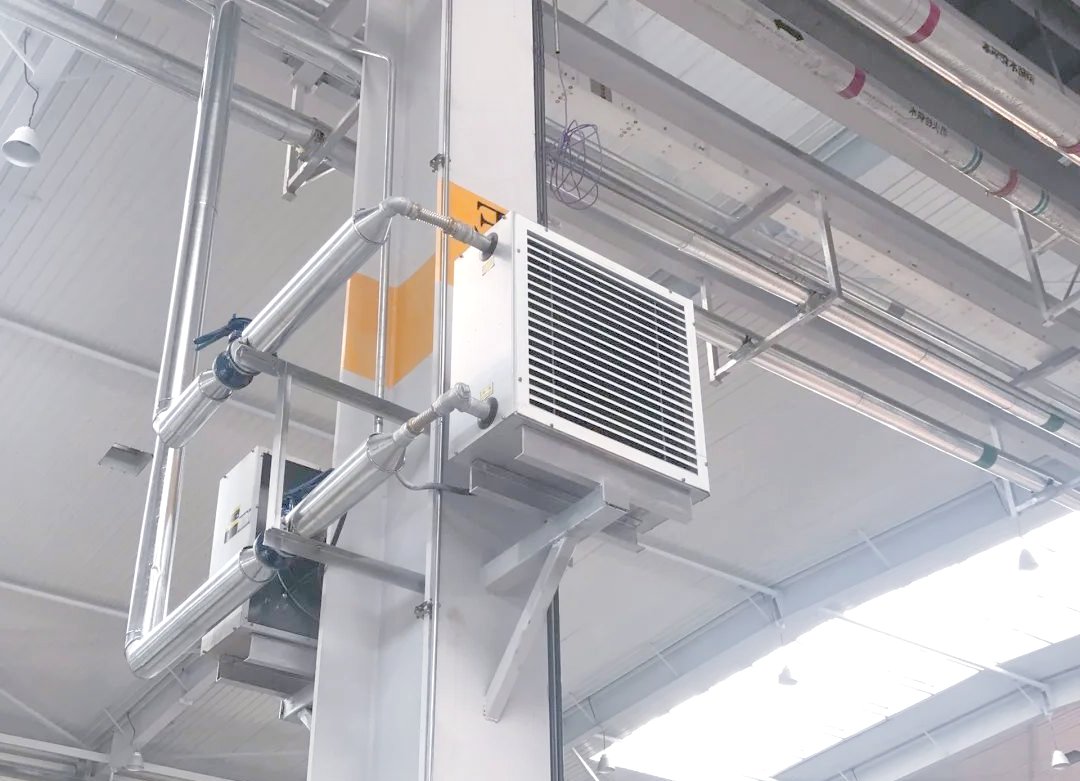
An industrial unit heater hung from the roof structure, hot-water pipework and control valve in place
24 November 2026 · Selection note
Last winter a machine-shop owner came to me with three quotations. Same 1,000 m² workshop: one price around RMB 80,000, another RMB 260,000. He asked whether the expensive one was trying it on.
I laid the three sheets side by side and went through them. The expensive one was not necessarily cheating, and the cheap one was not wrong either — the problem was that the three schemes were not the same thing at all: one was industrial unit heaters, one was radiators, one was central air conditioning.
Before price, look at three things: how big and how tall the workshop is; whether the plant already has hot water or steam; and whether production runs continuously or in shifts.
Above six metres clear height, warm air keeps climbing. If the supply jets swirl up at roof level, the floor never warms. Natural convection from radiators is slow in that situation; unit heaters that push warm air downward and spread it along the aisles suit it much better.
If the plant already runs a boiler, steam or process waste heat, hot-water radiators and hot-water unit heaters both cut running cost sharply. With no heat source and electricity only, power is the main cost — work the tariff into the numbers instead of staring at the equipment price.
A workshop on three continuous shifts wants stability: radiators with a night setpoint do the job. A workshop that runs by day and stops at night wants fast warm-up, and unit heaters are the better fit.
Most people compare equipment prices only, and that is where money gets lost. A unit heater is cheap, but add the cable, the distribution capacity upgrade and the hangers. Radiators need pipework, valves, a circulation pump and a heat-exchange station. Central air needs the outdoor unit, terminals, water and air ducting, insulation, roof loading and service space.
For a 1,000 m² single-storey workshop, six metres clear height, 120-day heating season, installed capital cost comes out roughly as: industrial unit heaters RMB 40 to 70 per m²; radiators RMB 60 to 100 per m²; central air RMB 150 to 260 per m². These are ordinary-condition ranges; electrical upgrades or roof strengthening push them higher.
| Scheme | Capex (RMB/m², installed) | Running cost (RMB/m²·season) | Where it suits |
|---|---|---|---|
| Industrial unit heaters (electric) | 40–70 | 25–45 | High clear height, intermittent production, fast warm-up needed |
| Radiators (hot water / steam) | 60–100 | 18–30 | Boiler or waste heat available, continuous production, stable temperature |
| Central air (air-cooled heat pump + terminals) | 150–260 | 40–65 | Summer cooling also needed, clean-room or comfort requirements |
Estimates for a 1,000 m² single-storey workshop in Shandong, six metres clear height, 120-day season. Actual figures must be worked out per project.
You cannot compare running cost by the price of a kilowatt-hour alone. Heat source, efficiency and running hours belong in the same calculation.
An electric unit heater turns roughly 0.95 kWh of electricity into heat per kWh consumed. At RMB 0.65 per kWh, eight hours a day for 120 days, that is RMB 25 to 45 per m²; zoned or intermittent operation brings it lower.
Hot-water radiators, with a gas boiler already in the plant, work out at RMB 18 to 30 per m² once gas price and boiler efficiency are converted. If you have to fire a dedicated boiler for heating alone, the cost rises noticeably.
An air-cooled heat pump feeding fan coil units or a ceiling-mounted air handling unit costs RMB 40 to 65 per m² to run, and it also cools in summer, gives even temperature and works in clean rooms. Whether that money is well spent depends on whether your plant needs it in winter only.
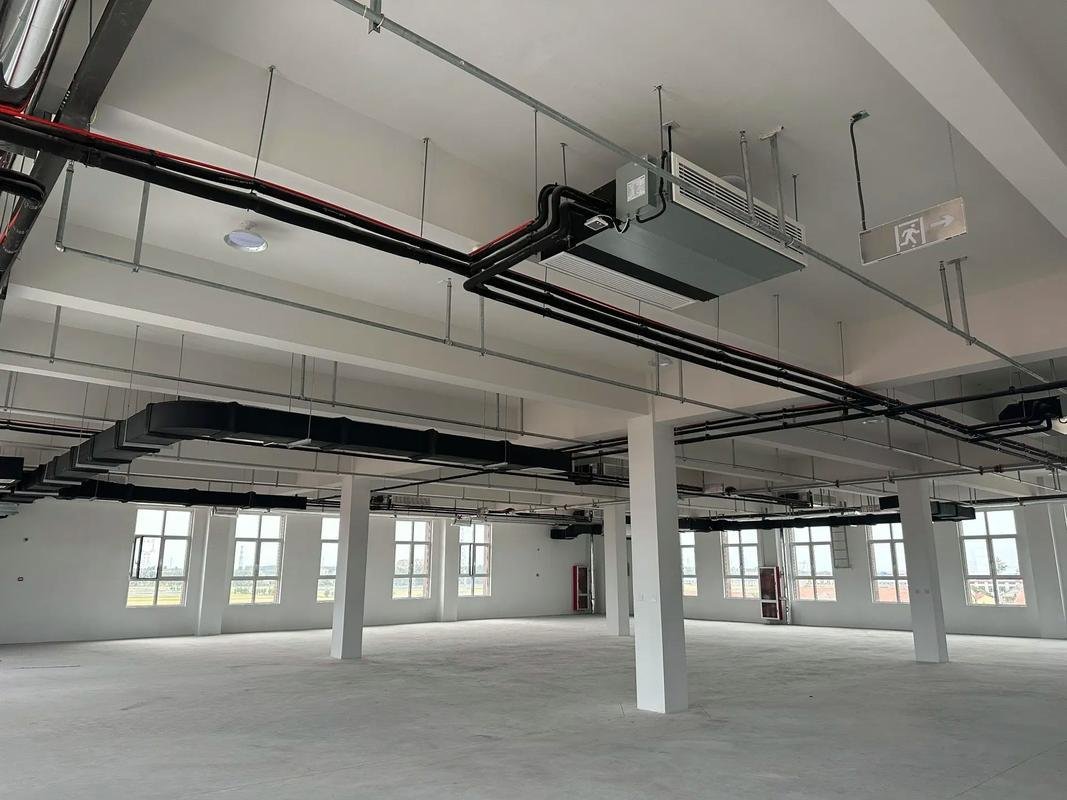
Ceiling-mounted AHU, ducting and water pipes installed at roof level
Under 1,000 m², single storey, I often combine zoned unit heaters with local radiators: unit heaters for fast warm-up over the main work area, radiators to hold temperature at the corners and in the duty room. Capital cost lands around RMB 60,000 and running cost is about 20 percent below all-electric.
Large area, high clear height, continuous production: hot-water radiators as the base load, unit heaters as back-up, heat from the plant’s existing boiler. That combination is the cheapest to run.
Only where cleanliness matters or summer cooling is also needed is central air the recommendation — and then the sums must cover the whole year, not winter alone, or the winter figure will look expensive.
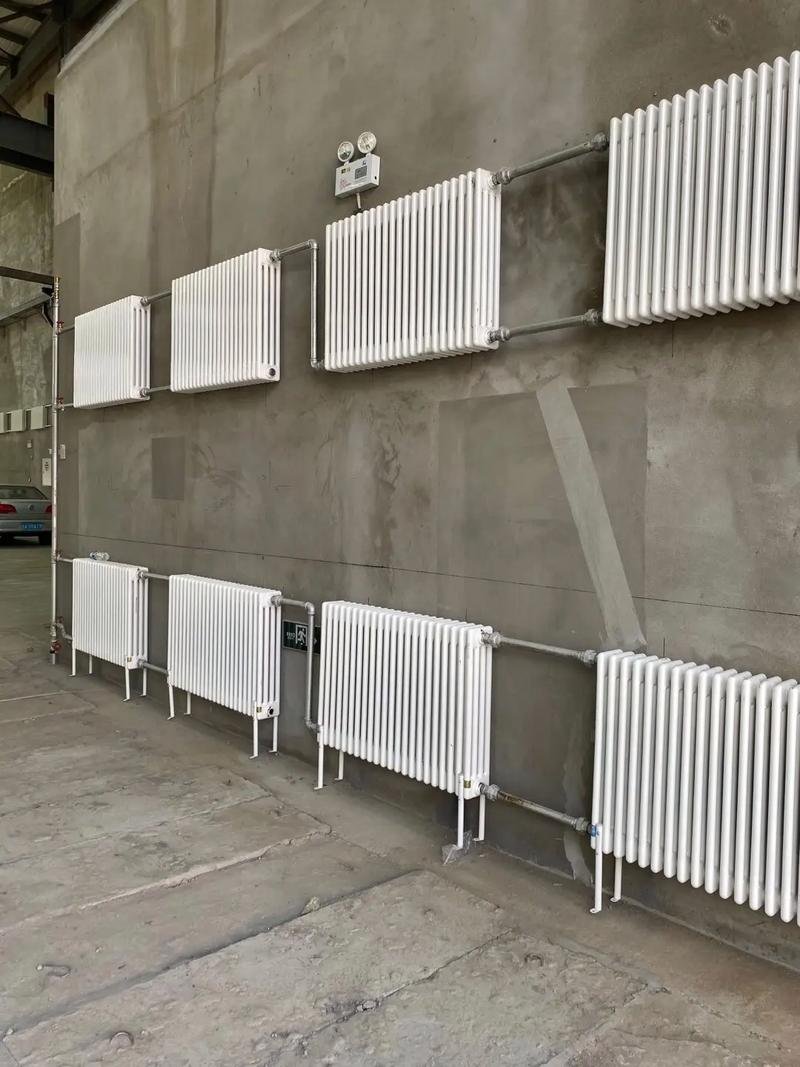
Radiators and hot-water pipework in a row along the factory wall
Electrical capacity. Ten 8 kW unit heaters is 80 kW, and the switchgear in an old workshop often cannot carry it. Upgrading the supply frequently costs more than the equipment, so put it in the proposal.
Air pattern. A unit heater must not blow straight at people, nor straight down from the roof. Direct it downward at an angle along the aisle so the warm air spreads across the floor and then rises.
Night setpoint. A workshop does not need 18 °C round the clock. Hold 5 °C overnight to keep pipes from freezing, start the warm-up an hour before the shift, and running cost drops by around 30 percent.
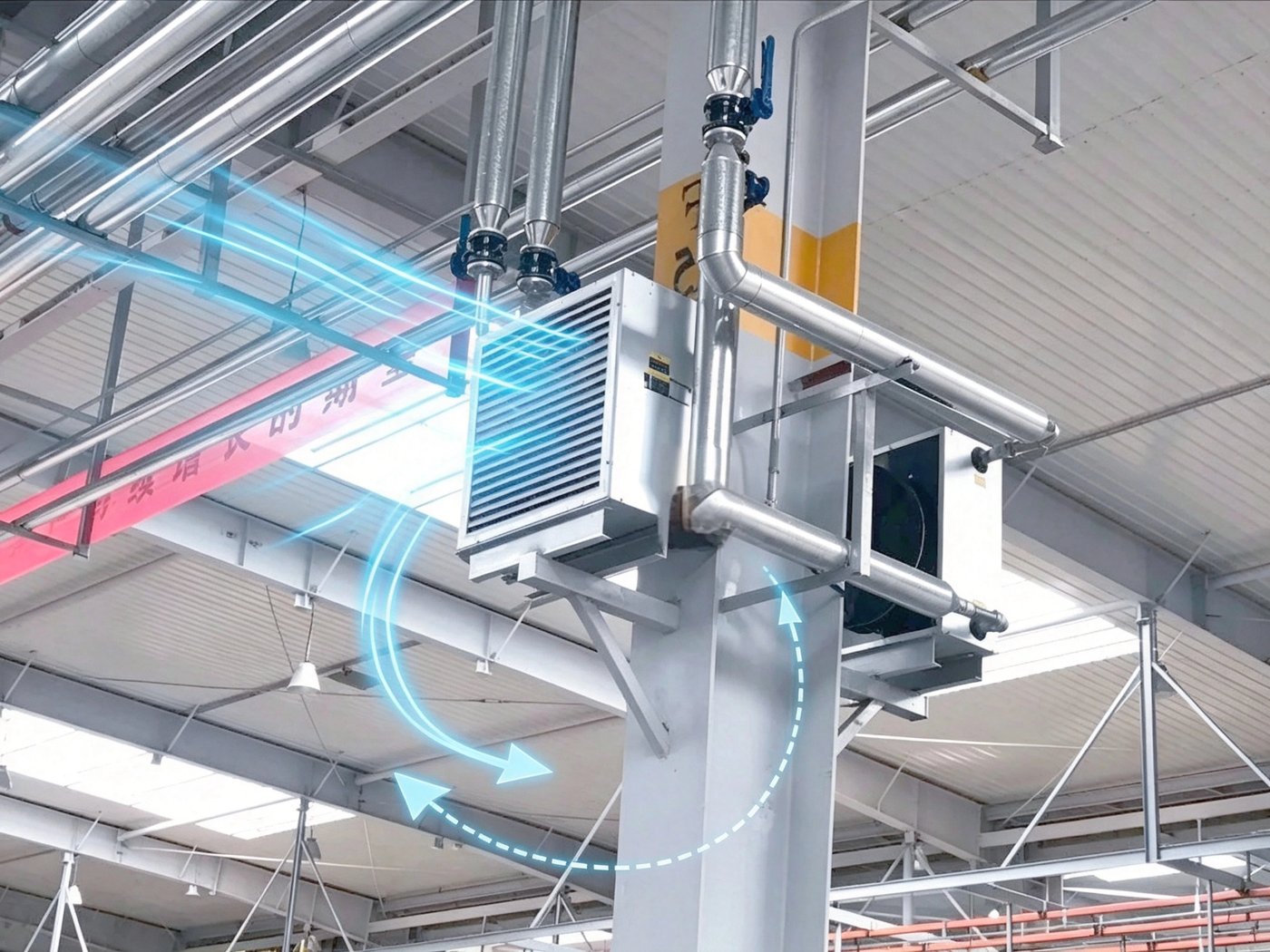
Unit heater discharge angled down along the aisle: warm air spreads on the floor and then rises
There is no absolute good or bad factory heating scheme, only one that fits your workshop. State the area and clear height, the heat source available and the production pattern, then ask the supplier to quote the whole system with capital and running costs listed separately. Only then does price comparison mean anything.
Recommended products
Unit heaters: DeLENG Q series industrial warm-air heater, hung or floor mounted, with electric, hot-water or steam heat source.
Coils and heaters: central air conditioning cooling coil and air heater, drawn and checked by air volume and water temperature.
Fan coils: FP-WA concealed horizontal series and the 200 mm ultra-thin quiet version, with standard and optional items priced separately.
Air handling units: ceiling-mounted, vertical and modular AHUs configured for clean-room or constant-temperature duty.