In one line: on a fan coil unit the standard scope is the casing, the coil, the centrifugal fan with three-speed motor, the condensate pan, and the factory hydrostatic test with certificate. Return-air box, filter, brushless DC motor, lift pump, thermostat, motorised valve and anti-corrosion treatment are priced options — leave them off the quotation and you have left the door open for variations later.
Three points to judge by:
The price gap on the same model comes mainly from three places: motor type, return-air box and filter, and the temperature-control package.
The two commonest tricks are a quotation that lists only model and quantity, and airflow quoted at high speed but supplied at medium.
Asking the supplier to price eight configuration items, and writing “accessories as per list” into the contract, is more useful than arguing the unit price down.
Not long ago a procurement manager on a hotel refurbishment brought two quotations: same model, one RMB 80 cheaper per unit. He asked whether the dearer supplier had added a margin. I said not necessarily — go through the configuration item by item; most likely the cheap one is missing three things.
I see a lot of these sheets. In this industry the casings all look alike; the difference is in the small print at the bottom of the quotation.
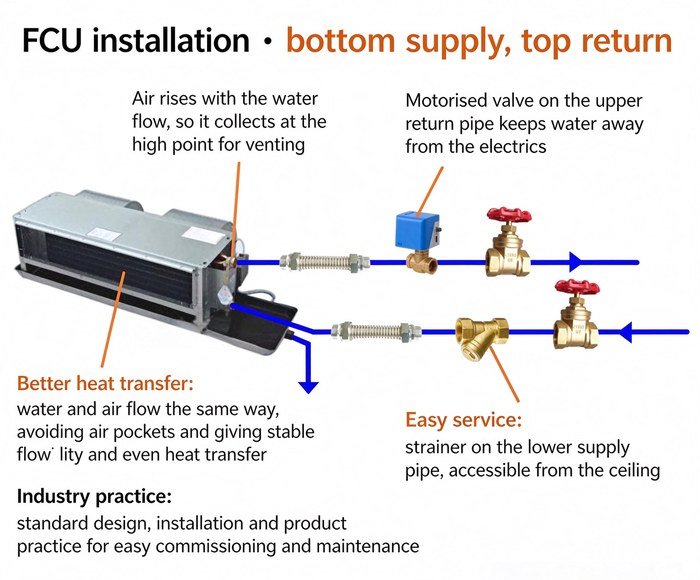
Fan coil installation schematic: bottom supply, top return
First, the standard scope. A conventional concealed horizontal fan coil unit should leave the factory with: galvanised steel casing; copper tube with aluminium fin coil; double-inlet centrifugal fan and three-speed AC motor; condensate pan with reversible left/right connections; factory hydrostatic test, nameplate and certificate.
That is the unit doing its job — it should not appear as a separate charge. The FP-WA concealed horizontal fan coil unit has nine models, 230 mm body height and 340 to 2,380 m³/h airflow, and the standard scope is exactly the list above. If a supplier charges separately for the condensate pan, brackets or connection direction, ask them to write out the standard configuration first.
A surcharge is not strange in itself; not knowing where it comes from is. In project work there are broadly four categories.
Performance. Brushless DC motor, usually quoted as using 30 percent less power than AC; high static pressure versions; extra coil rows or a larger coil area. All three are real cost.
Installation. Return-air box, with or without a filter — a big price difference; condensate lift pump; silencer plenum and flexible connector; extended connections. These depend on site conditions, not every unit needs them.
Controls. LCD thermostat, networked thermostat, motorised two-way valve, BMS interface (0-10 V or Modbus). Controls are where confusion is easiest, because quotations often say “controls included” without saying which.
Materials. Stainless steel or colour-coated casing, non-standard colours, anti-corrosion fins or thicker copper tube for coastal and chemical sites.
One more easily missed: the ultra-thin body is a separate tier. On the same nine airflow steps, the 200 mm ultra-thin concealed quiet fan coil unit costs more than the 230 mm standard version, because the coil has to go in at an angle and the air path is redesigned — 30 mm less height, more process cost. Where ceiling depth is tight, that money cannot be saved.
First, model and quantity only. One line on one sheet: “FP-68 concealed horizontal, 9 units”. There is no way to compare, because the configuration lives in verbal promises; after award it is varied item by item, and the variation orders end up dearer than the original.
Second, mixed airflow figures. Quoted at high speed, supplied at medium; or cooling capacity at standard conditions while the site water temperature never reaches them, so the unit is undersized once installed. Always ask which airflow step and which conditions the price refers to.
Third, charging for what should be free. Left/right changeover, a different connection direction, a moved panel cut-out — on most production lines these are done in passing; a separate customisation charge is out of place.
And a subtler one: “brand-name motor”, “imported chip” as a reason for a surcharge, with no model number. If no model number is offered, do not accept the surcharge.
My method is blunt: ask the supplier to price eight items — model; airflow step (high, medium, low); coil rows, tube diameter and fin type; motor type; return-air box and filter included or not; thermostat and motorised valve included or not; tax, freight and brackets included; delivery time.
Compare only once the eight match; then a higher unit price means something. On the same configuration the dearer supplier usually has a reason, and the cheaper one cannot hide.
Then add one line to the contract: accessories as per list. That sentence removes most of the arguing later.
| Configuration item | Standard or option | How to word it on the quotation |
|---|---|---|
| Casing (galvanised steel, electrostatic coating) | Standard | State material and sheet thickness |
| Coil (copper tube, hydrophilic aluminium fin) | Standard; rows or extra area priced | State rows, tube diameter, fin type |
| Double-inlet centrifugal fan + three-speed AC motor | Standard; BLDC is an option | State motor type; no model number, no surcharge |
| Condensate pan, reversible connections | Standard; lift pump and extended connections optional | State whether lift pump and connection direction are included |
| Return-air box, filter | Common option | State box included? How many filter layers? |
| Thermostat, motorised two-way valve | Option | Give model numbers; state whether valve included |
| Stainless / colour-coated casing, anti-corrosion fins, thicker tube | Option | State the environment and the treatment |
| Factory hydrostatic test, nameplate, certificate | Standard | List in the delivery documents |
In project procurement the risk is not paying a lot, it is not knowing where the money went or where it was saved. Fan coils are the highest-volume terminal product: tens of yuan per unit across hundreds of units is tens of thousands, and a configuration that does not match costs far more in commissioning and rework.
These standard configurations are listed model by model on the DeLENG product pages, so they can be checked before ordering.
Which items are standard on a fan coil quotation?
Casing, coil, double-inlet centrifugal fan with three-speed AC motor, condensate pan, and the factory hydrostatic test with certificate. Return-air box, filter, BLDC motor, condensate lift pump, thermostat and motorised valve are options.
Why can the same model differ by tens of yuan?
The difference is configuration, not casing. AC versus BLDC motor, return box and filter in or out, thermostat and valve in or out — those three pull tens of yuan apart.
Are the return-air box and filter standard?
Most factories quote them as options. If the quotation does not say whether the box is included and how many filter layers, delivery easily turns into a variation.
Why is the 200 mm ultra-thin unit dearer than the 230 mm one?
Thirty millimetres less body height means the coil goes in at an angle and the air path is redesigned, so process cost rises. Where ceiling depth is limited it is the only choice, and the difference cannot be avoided.
Which items on a quotation are most worth checking?
Eight: model; airflow step; coil rows and tube diameter; motor type; return box and filter; thermostat and motorised valve; tax, freight and brackets; delivery time. Compare on the same configuration.
Related products
FP-WA concealed horizontal fan coil unit — FP-34 to FP-238, nine models, 230 mm body, 340–2,380 m³/h, down to 35 dB(A).
200 mm ultra-thin concealed quiet unit — nine models, 200 mm body, angled coil with pure copper tube, 5–60 m².
KM series 4-way cassette — nine models, four-way discharge, gravity drain with no pump, BLDC option saving 30 percent.
WSK-8A LCD fan coil thermostat — 5–35 °C, ±1 °C, 86-type box, infrared remote.