The unit runs fine all year, then as soon as the temperature drops below zero the building manager switches it off. We see this several times every winter. Go to site and ten to one the problem is not the equipment itself but three things around it: the drain, the low-temperature protection and the way it is run.
In cold, damp weather frost forms on the surface of a total heat exchange core. The frost layer thickens, airflow falls, and when it defrosts the condensate volume jumps. What actually takes the unit down is usually not the core but the path the condensate takes: the drain pipe freezes, the trap freezes solid, the drain pan splits, and water backs up into the unit.
So the order on site is: water path first, controls second, equipment last. Our own total heat exchange fresh-air ventilator works in low temperatures, provided the installation around it leaves the condensate somewhere to go.
For a ceiling-mounted unit, three items must be checked before winter:
① The drain needs fall. Slope towards the discharge point, with no low spot in between. Insulate the outside of the pipe throughout, and add a heat-tracing section where the run passes an external wall or sits outside the ceiling.
② The trap must exist — and must be insulated. A trap stops cold outdoor air coming back up the pipe, but it is also the first thing to freeze. Fitting one and leaving it bare just moves the freeze point.
③ Do not leave the intake bare. Fit a rain and snow hood on the external wall opening, and do not skimp on insulation where the duct passes through the wall — thin material packed out for thickness still condenses and freezes in winter.
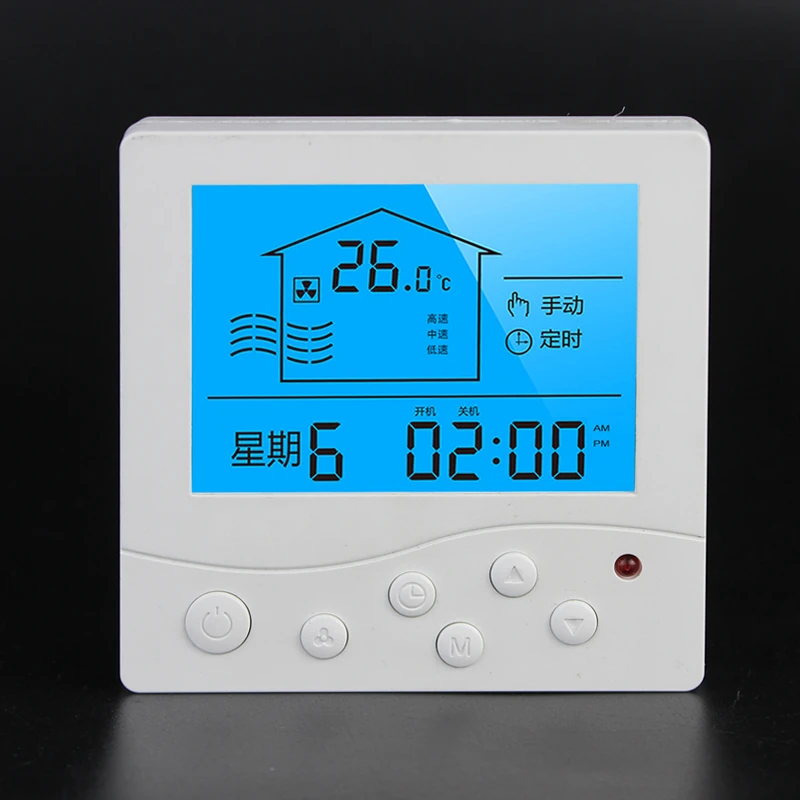
WSK-8K fresh-air LCD controller: temperature, mode and time schedules on one panel
A controller with low-temperature protection can hold an intake-air lower limit: below that value it steps down or stops, and resumes when the temperature returns. The WSK-8K fresh-air LCD controller we supply works exactly this way — set the low-temperature protection together with the time bands in the menu, and it is far more reliable than someone watching the clock to switch the unit off.
Where the unit has a preheat coil or electric preheater, do not reverse the start sequence: preheat first, then open the fresh-air damper. Bring both on together and the fresh air arrives before the preheat is warm — the preheater might as well not be there.
In cold weather run low speed continuously rather than on by day and off by night. Repeated starts frost and defrost the core again and again, the condensate flow swings, and the drain system is more likely to freeze. This is the cheapest measure and the easiest to overlook — someone always thinks switching it off saves power.
Clean the filters when they need it. A dirty filter cuts airflow and the frost blocks faster. A clean before the cold snap costs less than pulling the unit apart after it has frozen.
1. Drain fall, pipe insulation and heat tracing — check each before winter.
2. Controller low limit and time bands — do not leave the factory defaults.
3. Operating mode set to continuous low speed, filters renewed.
We build ceiling-mounted and vertical fresh-air units as standard, and non-standard sizes to site drawings. Ceiling-mounted fresh-air AHUs come in jet and standard versions. For selection or a revised control scheme, call +86 534 2555668 and the technical desk will work it through with you.
Dezhou DeLENG Air Conditioning Co., Ltd. · fan coil units / air handling units / heat recovery ventilators / cooling coils
A fresh-air project to size for air volume and filtration?
Send the room area, clear height, occupancy and fresh-air target, and we will come back with airflow, model and filter configuration for the project.